Pages

Tuesday, December 22, 2015

THE ZSL LONDON ZOO ON TRANSFERWARE


Zoological Gardens Regents Park.  Notice the Clock Tower (weather vane on top) on the right.

The London Zoo appears on many pieces of 19th century transferware,  so I decided to visit the zoo when I was in London for the annual meeting of the Transferware Collectors Club.  (A brief history of the zoo can be seen in my post "Transferware Zoo Patterns #1").  A few of the original buildings not only exist, but are still in use.  Unfortunately, these buildings are not well represented on the zoo patterns.  That said, I needed to look carefully at the zoo patterns in the Pattern and Source Print Database of the TCC.  It was a bit like "find the hidden picture" game I enjoyed so much as a child.

The Clock Tower (1828), designed by Decimus Burton, the zoo's first architect,* appears on many lithographs of the early zoo.  It was built to house llamas or camels, but now is used as a first aid station.  Almost all of the early 19th century animal houses are considered much too small for animals of any kind today.


The Clock Tower was designed in 1828 by the early zoo architect,  Decimus Burton. The clock was added in 1831.  According to the ZSL website,* the building was rebuilt in 1844 as a Gothic house for llamas, and was rebuilt again in 1898.

An early lithograph of the Clock Tower by George Scharf (1788-1860), an illustrator for the ZSL, is complete with llamas (although they look like camels to me).  Notice the Gothic trim on the side of the building.

The Clock Tower is near the bear pit in the center of this print.

The Clock Tower is described here as housing camels.  Camels are in the same family as llamas, but the London Zoo website says llamas were housed in the clock tower building.


Robinson, Wood & Brownfield (1837-1837) "Zoological" soup tureen showing the Clock Tower on the left.  Notice the same Gothic trim that is seen in the prints above.  (click to make the photo larger)

The Ravens' Cage (1829) was also designed by Decimus Burton.  According to the sign, it was originally used as a summer residence for macaws, and it later housed ravens.  It was used recently as a feeding station for sparrows, but it is mainly of historical interest.  The cage suffered severe damage during the bombing of London during World War II, and was rebuilt.


Ravens' Cage, ca. 1829 was designed by Decimus Burton. 

Ravens' Cage sign


The right side of the sign shows an early image of the Ravens' cage (click to make the photo bigger).


Robinson, Wood & Brownfield (1837-1837) "Zoological" pepper pot printed with, perhaps, the ravens' cage.

Davenport (1794-1887) child's plate "Zoological Gardens, Beaver House Aviary &c."  Notice the Ravens' cage on the right behind the tree.  (This may not be the Ravens' cage, but wishful thinking got the better of me).

The East Tunnel (1829-30), designed by Decimus Burton,  linked the North and South parts of the zoo for the first time.  David and I walked through it in October.

The East Tunnel at the London Zoo


East Tunnel Zoo Sign (once again, I suggest you click on the photo to make it bigger).


George Scharf print of the monkey cages and the tunnel (see it on the left).

Ralph & James Clews  (1814-1834) "Zoological Gardens" 10 inch plate shows the monkey cages, the aviary and the tunnel (see it on the left).


Podmore, Walker & Co. (1834-1859) footed bowl.  The inside of the bowl shows the aviary, the monkey cages, and the tunnel.  The outside of the bowl features the otter cavern.

The outside of the "Zoological" footed bowl shows the otter cavern.

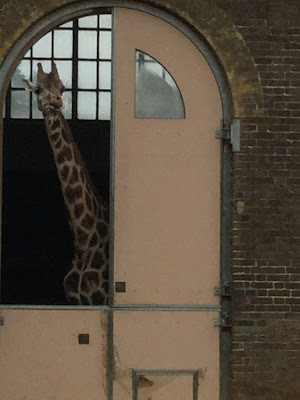
The giraffe house (1836-37) is still used for its original purpose; housing giraffes.  According to the ZSL, the zoo "received four giraffes in 1835; one female and three males.  Giraffes have occupied the house ever since.  Wings were added in 1849-50."  There was bomb damage in 1940, so the giraffe house was rebuilt in 1960-63.


Giraffe House at the London Zoo

Hi!

Giraffe at the London Zoo

A newspaper print of the original giraffes at the London Zoo.  Notice that the pediment (triangular part above the door) has been removed from the present giraffe house.  It was possibly another Victorian addition, and not original to the building.

John Ridgway  (1830-1841) "Giraffe" 14 inch platter.  Read about this pattern in my post titled, not surprisingly, Giraffe.

I have shown you mainly zoo patterns that feature buildings that are still at the London Zoo; the Clock Tower, the Ravens' Cage, The Tunnel.  The Giraffe House only appears on a newspaper print,  but the print shows the same giraffes found on the platter above.  The platter is copied from a George Scharf  (early zoo artist) print, which is seen below.

 
George Scharf print of "The Giraffes..."

There are two series that feature many London Zoo patterns;  "Zoological" by Robinson, Wood & Brownfield and "Zoological Gardens" by Ralph & James Clews.  Not surprisingly, there are also many zoo patterns found on children's plates.   That, however, is a post for another day.

One more thing.  As I was leaving the zoo, I noticed posters that showed some of the endangered animals that are helped by the ZSL (Zoological Society of London) or, more simply, the London Zoo.   I always need to be reminded that zoos are not only for children's or adult's entertainment, but are societies that help preserve animals.  The ZSL was originally formed in 1826 to study animals, and it still does.  A good place to learn more about the ZSL is their website and their Facebook page.

The Asiatic lion is the one featured in the Bible!  Let's preserve him.

If you want to know more about the pangolin, the only mammal with scales, see my post on pangolins.
 
 *Information about the architecture at the zoo can be found here.

Monday, December 21, 2015

THE SIXTH COMMANDMENT ON TRANSFERWARE


"The Commandments" 7 inch plate "Thou shalt do no murder" circa 1850
 
There is a series of 19th century transferware children's plates titled "The Commandments." The ten commandments are excellent patterns for children's plates, which were often intended as teaching tools as well as gifts.  Although the pattern above may seem inappropriate for young children, it is a starting point to teach children about the sanctity of every life.  It is also an opportunity to discuss the difference between killing and murder.

I have been thinking about murder lately.  What constitutes murder?  How is is different from killing?  Is there a difference?

The Biblical injunction "Thou shalt not murder" orders us not to take the life of another human being.  However, there are Biblical exceptions such as battle, self-defense, and the death penalty.  These deaths may be justified.  By extension, there are also accidental (without intent) deaths caused by mistake and negligence. Arguably, these are not murder.   However, "Thou Shalt Do No Murder" is clear about some deaths.  Unjustified and planned killing of unsuspecting and innocent people in a bar in Paris or a holiday party in San Bernadino is murder.  It is as simple as that.  At least, it may be  simple to a child. 


Sunday, December 13, 2015

THE TCC ENGLAND TOUR 2015: PART FIVE - MIDDLEPORT POTTERY


I hadn't been to the Middleport Pottery before, but I was very familiar with their popular "Calico" pattern, seen above with the remains of a delicious lunch.  I always called it Blue Calico, but its name is just Calico.


The factory, originally operated by Burgess, Dorling, and Leigh (known as Burleigh), is the oldest working Victorian pottery in Staffordshire.   It continues to make pottery in the old way, as you'll see; think hand transfer printing.  The pottery was purchased by the Prince's Regeneration Trust in 2011.  This made it financially possible for an extensive renovation of the factory.   It also allowed the traditional work done in the factory to be preserved for present and future generations.


Bottle oven at the Middleport Pottery

Above is one of the  original bottle ovens, which historically was fired by coal.  Today the pottery is fired in an electric oven (better for the environment and workers!).   We were told the plants, seen on the outside of the oven, would never grow when the oven was working; it would be much too hot.


Along the canal, there are planters filled with flowers, Canada geese, and a gorgeous blue and white pottery wall.
The Middleport pottery is located on a canal, which made it fairly easy to transport the finished products.  Today, the path beside the canal is a lovely place to walk.


Steam Engine
Inside, there is beautifully preserved equipment, lots of pots, and many workers.

Slabs of clay

Clay cutter; like the cheese cutter my mother used to use.

Saucer molds

Plates waiting to be decorated

Notice the transfers hanging on a line.

Transferring

Cups waiting for the oven.  The purple color will become blue in the oven.

The electric oven is a bit different than the bottle oven above!


Finished pattern is now blue!  These pots are for sale in the factory shop.


The factory shop showed an abbreviated primer of the pottery process written on scrap paper and modeled by clay and clay pots.


Part I: Clay and Greenware Item


Part II: Biscuit Ware and Glost Finished

Below are some lovely items for sale in the factory shop.


Burgess & Leigh Middleport Pottery Shop/A dresser filled with blue and white pottery and more plates on the wall.

Cow creamers

I decided to add a photo of the cow creamers sold in the shop, as cow creamers have a long ceramic history in England.  You can see  19th century cow creamers in my blog post The TCC England Tour 2015: Part Three - The Potteries Museum And Art Gallery.  You may also want to check out the TCC England Tour 2015:  Parts One, Two and Four; The Victoria And Albert Museum Keele Hall And The Raven Mason Collection,  and Spode.


Sunday, December 6, 2015

WOLVES ON TRANSFERWARE AND A FAIRY TALE


"Dusky Wolf" 2 inch high child's mug, ca. 1820/Notice the dead rabbit under the wolf's paw.
 
I want to tell you a fairy tale about how a wolf became good.  This is a particular wolf, not wolves in general.  I made up the story last year when my four year old granddaughter became separated from her parents at a large International Airport.  I wanted to impress on her the importance of staying close to parents even when you think you know where to go.  Even if you are afraid of nothing (except the dark).  


How the wolf became good – A fairy tale

Once upon a time there was a little wolf.  He liked to pretend how bad he was because his parents thought he was too good!  He decided that he would be the badest wolf ever! 

One day he saw a little girl at the airport.   The wolf noticed that she didn’t listen to her parents, and he thought he could use this to his advantage.  He waited until the little girl’s mother was busy lugging a heavy suitcase and her father was carrying her brother.  The wolf knew the girl would sneak away.  He knew this because he would have done the same.  He watched her go down the stairs and out the door of the airport!   Her parents didn’t even notice that she was gone!  The wolf went after the girl.  He was going to eat her!  He was sure this would please his parents.  However, when he thought how scared the girl would be, he remembered that when he did things that were dangerous he always thought his parents could save him.   The wolf knew the girl’s parents couldn’t save her because they didn’t know she was gone.  He knew he had to save her, and he realized he could never be bad.  He could be big someday, but not bad.

The wolf took the little girl back to her parents, but they thought he was trying to hurt her!  They yelled at him and made him cry.  The little girl told her parents the wolf saved her.  She explained that she had walked away from them, and the wolf had brought her back.  The wolf was a hero.

The parents, the little girl, and the wolf hugged.  The parents thanked him and said he was always welcome to visit.  The little girl learned it was dangerous to leave her parents at a busy airport (or anywhere).  She promised to listen to them.  She told the wolf he was good.  She  also said she would never believe a fairy tale that said he was bad (only some wolves were bad and some people too!).


Maya asked the wolf to be her pet and live with her, but he explained that he was a wild animal and thus not pet material.  However, he would be her friend.
 The End!

Since you stayed with me this far,  I thought I'd show you more transferware patterns that feature wolves, starting with a gravy boat from one of my favorite series: "Quadrupeds."


John Hall (& Sons) 1814-1832 "Quadrupeds" gravy boat printed with a New South Wales Wolf.  The wolf is copied from a Thomas Bewick print from his "A General History of Quadrupeds," 1790.

Lots of wolves appear in "Aesop's Fables."  The fables are as meaningful today as they were in ancient times.  Is the wolf more like humans than the other animals?

Copeland & Garrett (1833-1847) "Aesop's Fables" series "The Sow and the Wolf."  The series was begun during the end of the Spode period, and continued throughout the 19th century and into the 20th. 

William T. Copeland (& Sons) 1847-1970 "Aesop's Fables" soup tureen with the pattern "The Wolf, the Lamb and the Goat."  It was probably made in the late 19th century.

Spode (1770-1833) "Aesop's Fables" sauce tureen "The Dog and the Wolf."  It probably dates from around 1831.

Spode (1770-1833) "Aesop's Fables" vegetable tureen base "The Wolf and the Crane." It also dates from the end of the Spode period.


Thomas & Benjamin Godwin (1809-1834) "Aesop's Fables" 5 inch child's plate "The Shepherd's Boy."  This fable is also known as "The Boy Who Cried Wolf."

Mintons (1872-1950) Aesop's Fables 6 inch tile "The Wolf & The Lamb at the Spring."

One of my favorite fairy tales is "Little Red Riding Hood."  I have written about it in my blog post "In The Wood Or Little Red Riding Hood Again."  Little Red's wolf is not very nice.  He certainly tricks her.  However, there are good lessons to be learned from the story.  For example, "Listen to your mother!"
"Red Riding Hood Meets The Wolf" 7.12 inch 19th century child's plate.  The pattern illustrates the letter "R" for the word "Red."

Brownhills Pottery (1872-1896) "Red Riding Hood Meets The Wolf" 7.25 inch plate. 

Josiah Wedgwood (1759-2005) "Death of the Wolf" 6 inch tile, late 19th century.  I thought the woodman killed the wolf, but fairy tales have many variations.  I do wonder what killed him.  Perhaps indigestion from eating granny?

There are lots of things to learn from fairy tales and fables.  For example, not everything is as it seems.  The End.

Wednesday, November 25, 2015

THE TCC ENGLAND TOUR 2015: PART FOUR - SPODE


Spode Italian dinner plate, ca. 1976/The plate is from the wonderful dinner service my parents gave me as a wedding present in 1976.

One of the most famous manufacturers of English ceramics is Spode.  The factory was in business on the same site (see the history of the factory ownership here)  for almost 250 years, and made some of the most enduring and beautiful transferware patterns;  Italian, for example, was made from circa 1816 until the factory closed around 2009.

I have a long history with Spode's  Italian.*  I was given 133 pieces (new) as a wedding gift in 1976.  The dishes have appeared at all of my Thanksgiving dinners since November 1976!


Spode Blue Italian on my Thanksgiving table.

I have other Spode patterns too.  For example, I spotted a Spode platter at an antiques shop in 1977 that reminded me of my honeymoon in Rome.  The pattern is actually called Rome!  The platter has resided on my dresser for nearly 40 years.


  The Rome pattern Spode platter has been on my dresser since 1977.  The platter dates from the early 1820s.  The dust on the shelf is old too.

This is a preamble to explain why I was happy the  TCC  2015 tour included a visit to the old Spode factory site, which is now known as the Spode Works Visitor Center.  The visit included a demonstration of the transfer process by Paul Holdway,* and a look at a collection of transferware items and copper plates.


Paul Holdway inking a copper plate/Notice the Italian pattern tissue pulls on the right.

Paul pulling the tissue away from the copper plate/ To see a YouTube video of the whole transfer process follow this link.

Some of the items in the transferware display.  The bidet on the bottom right is printed in the Tower pattern, above is a tureen in the Greek pattern, and the jug on the top right is Woodman.  If you want to know the rest of the patterns, an excellent resource is Spode Exhibition Online.  You can go right to the printed designs here.

Spode display/The item on the top left is a leg bath. 

More Spode

Greek pattern copper plate
Floral pattern copper plate.

Why was Spode so important? Why should the site be preserved?  The factory made useful and beautiful things for more than 200 years, but the poster below illustrates that not only beauty, but science, historical material, and community were fostered at the site.   It is part of English history.


The text on this poster explains the importance of saving the Spode factory.

I have been to the factory site many times, and hope I can visit again.


I look forward to visiting again!

*If you want to know more about Spode's Italian pattern, follow this link to the Pam Woolliscroft's blog posts titled Spode & Italian on her blog Spode History.  You can also see a link to Richard's Halliday's 2013 book, The Italian Pattern.

*To see a You tube video of the transfer process by Paul Holdway which was produced by Richard Halliday, click here.

Take a look at the TCC England Tour 2015 Parts One, Two, and Three.


Tuesday, November 17, 2015

PARIS: FRIDAY 13, 2015

I have already written about another attack on the innocent; the Boston Marathon massacre of 2013.  I am sad that I am writing this kind of post again.  The murder of civilians in Paris on Friday 13, 2015 was a heinous crime. 


Jug, 5.12 inches.  The personifications of Peace and Plenty flank a large monument with the inscription "Peace of Europe Signed at Paris May 30, 1814", surmounted by the GR initials of George III.
 
There really isn't much 19th century transferware with a Paris pattern, but I did find "Peace of Europe Signed at Paris, May 30, 1814" in the Pattern and Source Print Database of the Transferware Collectors Club.  It illustrates both the sadness and the irony of a fragile peace treaty.  The pattern commemorates what appeared to be peace when Napoleon abdicated as Emperor in April 1814, and the Treaty of Paris was signed by the Allies; Britain, Prussia, Russia, Austria, Sweden, and Portugal.  Instead, in February, 1815, Napoleon escaped from exile on Elba, and was welcomed back by the French.  War broke out again, and didn't culminate until Waterloo in July, 1815.  There was a second Treaty of Paris that was signed in November, 1815.   Thus,  two peace treaties in little more than a year with, of course, war in between.   Notice that the second treaty was signed in November, 1815;  two hundred years before the recent killings in Paris.  I am meandering around what I wanted to say in my first sentence; plus ça change, plus c’est la même chose (the more things change, the more they stay the same).


Plus ça change, plus c'est la même chose)